“Peter very quickly established himself as a key member of the team, embedding himself in the problem space and leading user research efforts. Throughout our time together I've been thoroughly impressed by his ability to quickly adapt his approach depending on the context.”
Shoppable video: from MVP to multi-market launch
How I replaced redirect-based shopping with an embedded commerce layer inside the video surface, increasing CTR by 132% and scaling the model from the US to four European markets.
- Fintech
- Consumer mobile
Context
Klarna had 150M+ shoppers globally, and the app was becoming a key surface for content-driven shopping. The Social Shopping team was building new commerce formats to bridge content engagement and purchase through Klarna marketing solutions. Shoppable video did not exist yet. The brief: build from zero, validate in the US market, and design a system that could scale to five markets without bespoke builds per region.
The problem
Users were interested, but the flow broke context. Most comparable shopping video experiences used a redirect-to-product-page pattern. Stakeholders expected the same. High abandonment despite high intent suggested the pattern, not the product, was the problem.
Industry default
VideoIntentRedirect to PDPContext lostDrop-off
Context lost at every navigation step, drop-off correlated with hops, not with product interest.
Core insight
VideoIntentEmbedded CTACheckout
My role
Lead product designer on Shoppable Video, embedded in the Social Shopping team. I worked with product, engineering, research, analytics, and local market teams. My role was to turn fragmented evidence into a clear product direction, then reduce implementation risk through testable interaction models and a reusable component system. I owned the interaction model, the embedded commerce layer design, the component system, and the research pipeline, plus stakeholder alignment to make the alternative testable before asking engineering to commit.
- Kept product interaction inside the video surface instead of sending users to PDP
- Used progressive disclosure so product details appeared only after intent was shown
- Designed market configuration rules so local teams could adapt content without redesigning the flow
Research insight
The finding that changed direction: users were not losing purchase intent. They were losing emotional context. In session reviews, users often tapped with clear intent, but after landing on a generic product page they paused, scrolled, or exited instead of continuing to checkout. Drop-off correlated with navigation events, not price sensitivity or product interest.
Design direction
Embedded checkout preserved intent, but created risks around video clutter, accidental taps, localisation complexity, and performance. The design challenge was to make commerce available without turning the content experience into a product page.
Old flow
VideoPDPCartCheckout
New flow
VideoEmbedded CTAProduct detailsCheckout
Constraints
The solution had to work across five markets with different legal copy, pricing formats, and currency display, without requiring separate designs per region. It had to avoid cluttering the video experience, handle accidental tap recovery, and fit within Klarna's existing checkout architecture rather than bypassing it. Performance on lower-end Android devices was also a constraint, the commerce layer couldn't degrade the video playback experience.
Design exploration
Before committing to an embedded commerce layer, I tested five interaction patterns against the redirect baseline.
- [01]
Redirect to PDP
Industry default. Familiar to stakeholders, but broke emotional context at the first tap and repeated the drop-off problem in testing.
- [02]
Bottom sheet product preview
Preserved video visibility, but added friction for price comparison and introduced complexity for multi-item intent.
- [03]Selected
Embedded commerce layer
Commerce lived on the video surface. Best balance of intent preservation, measurable uplift, and scalability across markets.
- [04]
Add to cart without leaving video
Strong for repeat buyers, but weaker when users needed product detail before committing.
- [05]
Persistent cart / checkout entry
Useful as a supporting pattern, but not sufficient as the primary conversion path.
The embedded commerce layer won on all three criteria. It protected context without forcing a product-page mental model, reduced friction to a single tap, and could be configured per market through the component system. The decision was validated in A/B, not assumed from critique.
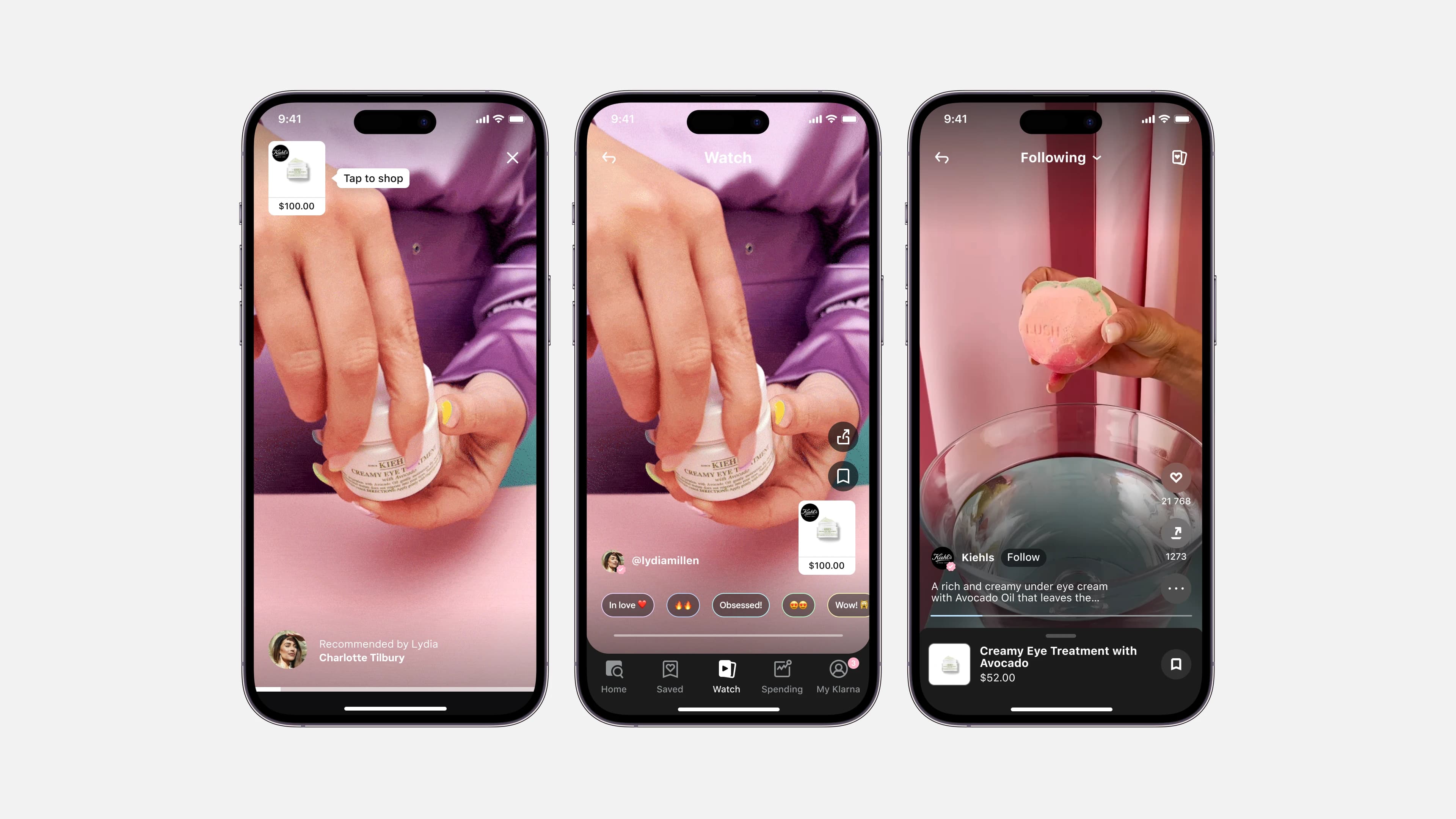
Final solution
Users could tap a product CTA on the video, review key details in-place, add to cart, and enter checkout without leaving the feed. Video context stayed visible through the decision, the emotional connection was not broken at the first tap.
- Embedded commerce layer on the video surface with progressive product detail
- Checkout entry directly from the video layer, no PDP redirect, no context switch
- Tracking states for each interaction step so drop-off could be isolated by action, not just funnel stage
System for scale
Same components, localised content. Each new market was a configuration change, not a redesign, which made the European expansion operationally viable after the US launch.
Component system included:
- CTA overlays
- Product cards
- Price & offer states
- Market-specific legal copy
- Localised currency & formatting
- Checkout entry states
- Fallback states
- Tracking states
Why it worked
The winning pattern did not increase intent. It protected intent. Users already wanted to buy. The product work was about removing the moments where that intent was lost, and building a reusable model that could scale across markets without one-off redesigns. After the US validation, expansion into UK, Sweden, Spain, and Germany did not require separate redesigns. Each market was a configuration change. That's the bigger operational impact, not just improving the funnel, but reducing the cost of scaling it.

Impact
Measured through A/B testing in the US market over several weeks during the MVP validation phase. CTR refers to product CTA taps from the video surface. Checkout conversion refers to users who entered checkout after engaging with the video CTA. Retention refers to users returning to shoppable video content within 7 days. Uplift is relative to the previous redirect-based flow in the same cohort.
CTR
6.5%
from 2.8%
+132% uplift
Checkout conversion
21%
from 12%
+75% uplift
User retention
39%
from 24%
+63% uplift
Recommendations
“Peter is nothing short of a top-notch designer who has seriously propelled Klarna becoming the world's #1 shopping destination through first-class design and phenomenally thought-through user experience, driven by both his expert eye for design and consistently accurate view, but also informed by data and what performs.”


Have a product flow that feels harder to explain than it should?
Send me your product, MVP, deck, or prototype. I'll tell you where I'd start.