“What stood out about Peter was his balance of visual craft and practical product thinking. He cared about clarity and consistency, not just aesthetics. He also brought strong systems thinking, particularly around design systems, reusable components, and scaling across English and Arabic.”
Mobile banking redesign for three user types
Led Rakbank's mobile banking redesign across three user types, retail customers, SME owners, relationship managers, using one shared token system. Reframed the brief from 'improve the design system' to a full digital transformation after an audit showed inconsistency was a systems problem. App Store: 3.2 to 4.6. Task completion +34%, support calls -28%.
- Banking
- Mobile
Context
Rakbank is UAE's largest retail and commercial bank. The mobile app served three fundamentally different user types: retail customers managing personal accounts, SME owners handling business finances, and internal relationship managers working with corporate clients. All three shared overlapping surfaces in one app. App Store rating: 3.2. 15 independent product teams shipping features with their own patterns, their own component interpretations, and no shared infrastructure.
Challenge
Visual inconsistency was the visible symptom. The deeper problem was cognitive. Banking apps are used in moments of real anxiety, checking a suspicious transaction is a different mental state from paying a bill. An app that feels inconsistent or unpredictable adds cognitive load at exactly the wrong moments. Fixing individual screens without shared infrastructure would produce new inconsistencies in the next sprint. And the three user types couldn't be served by separate app variants without tripling maintenance overhead.
My role
I owned UX direction, information hierarchy, persona differentiation, and visual language across iOS and Android. I also made the case, and got alignment, to build the token architecture before touching any screens. That's what turned the brief from 'improve the design system' into a full digital transformation.
What I changed
- Audited every major flow across all 15 teams before making any design decisions. The audit confirmed the diagnosis: inconsistency was a systems problem, not a screen problem. The brief changed. Building the token layer first gave every subsequent design decision a shared foundation.
- Rejected persona-specific app variants. One visual language, differentiated through information hierarchy. Retail: speed and balance visibility first, the most common task had to be immediate. SME: multi-account controls and transaction management. Relationship managers: data density and workflow support. Building three separate apps would have tripled maintenance and fragmented the codebase.
- Designed for speed-of-recognition. Banking is used in moments of anxiety, the metric that mattered was time to understanding, not time on screen. A suspicious transaction answer was buried 2 taps in. I moved it to the first screen. That one change reduced a support call category.
- Grew the design team from 2 to 8 during the engagement, establishing a shared working model across all 15 product teams.
Outcome
App Store rating: 3.2 to 4.6. Task completion: +34%. Support calls: -28%. 180K+ active users. The rating improvement reflected a product that felt like one thing, not 15 teams' worth of independent decisions stacked on top of each other.
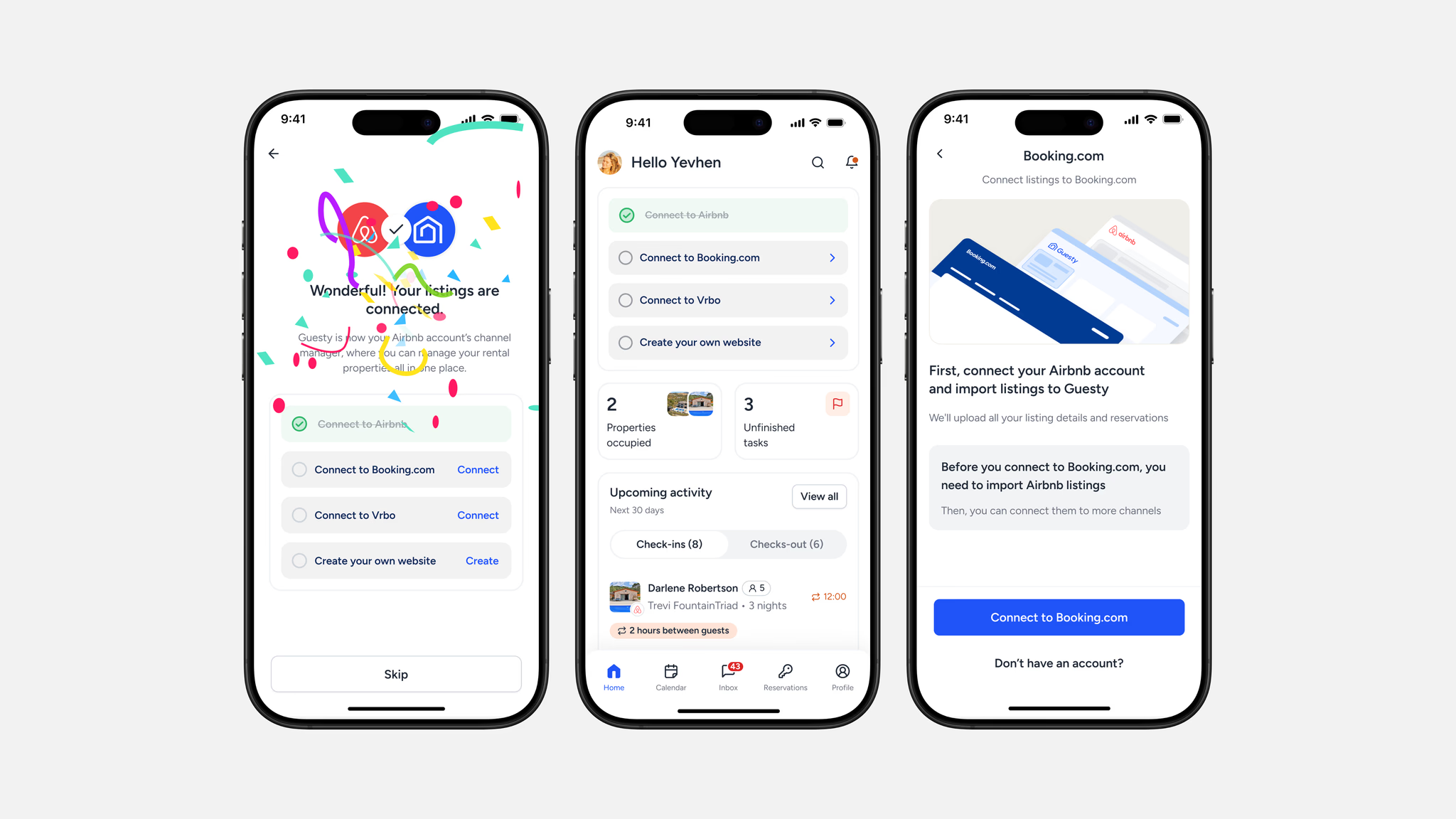
Mobile onboarding: from 70% drop-off to 38% trial conversion
Redesigned Guesty mobile onboarding by splitting Lite and Pro users into separate flows instead of a single flow with conditional logic.
Discount flow: from 80% abandonment to 90% conversion
Redesigned EasyPark's discount application flow on 457,000 annual transactions with 80% abandonment.
Have a product flow that feels harder to explain than it should?
Send me your product, MVP, deck, or prototype. I'll tell you where I'd start.